

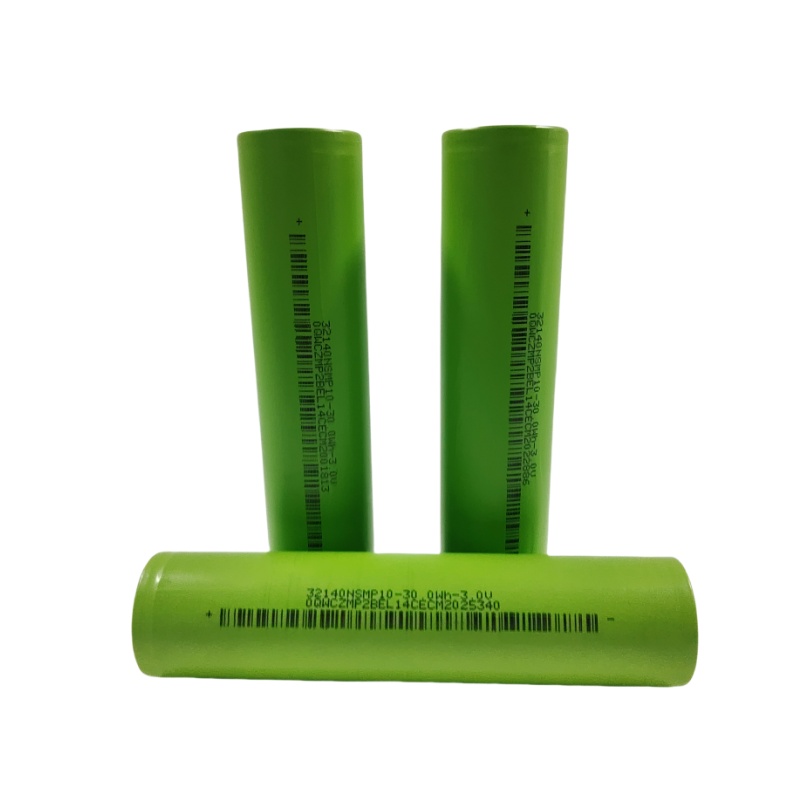
NaCR32140 32140 Sodium-ion Cell — 10 Ah
The NaCR32140-MP10 is a mid-power 32140 cylindrical sodium-ion cell: 10.0 Ah at 3.0 V with ≥ 110 Wh/kg energy density, 3C (30 A) continuous charge and discharge, 20C 3-second / 10C 30-second pulse capability, graded low-temperature charge voltages down to -20 °C and ≥ 5,000 cycles at 70% retention (0.5C, 25 °C).
Technical specifications
| Model | NaCR32140-MP10 (alt. marking 32140NSMP10), doc. no. HINA-SPE-013 |
|---|---|
| Nominal capacity | 10.0 Ah (0.5C discharge, 3.95–2.0 V, 25 °C) |
| Nominal voltage | 3.0 V |
| AC impedance | ≤ 3 mΩ (1 kHz, 3.2 V) |
| DC impedance | ≤ 10 mΩ (2C 30 s, 3.2 V) |
| Weight | 270 ± 5 g |
| Cell dimensions | Ø33.2 ± 0.2 mm × 140 ± 0.3 mm |
| Energy density | ≥ 110 Wh/kg |
| Charge cut-off voltage (graded by temperature) | 3.95 V (T > 0 °C); 3.65 V (-10 ~ 0 °C); 3.50 V (-20 ~ -10 °C) |
| Charge cut-off current | 500 mA (0.05C, T > 0 °C); 1000 mA (0.1C, T ≤ 0 °C) |
| Discharge cut-off voltage | 2.0 V (discharge to 0 V allowed) |
| Standard charge / discharge current | 5 A (0.5C) both |
| Max. continuous charge | 30 A (3C CC to 3.95 V, > 90% charged, temperature rise < 20 °C) |
| Max. continuous discharge | 30 A (3C CC to 2.0 V, > 90% discharged, temperature rise < 20 °C) |
| Rate charge capacity | 2C CC to 3.95 V: > 95% of rated (rise ≤ 8 °C); 3C: > 90% (rise ≤ 15 °C), 25 ± 2 °C |
| Pulse discharge | 20C for 3 s (short-time); 10C for 30 s (long-time); 25 °C < cell surface temperature < 60 °C, SOC > 50% |
| Discharge temperature range | -40 ~ 70 °C (stop operation beyond this range) |
| Reference standards | GB 38031 / GB/T 31486 / GB/T 31484 / GB/T 31485-2015 / UL 1642 |
Discharge capacity by temperature
| Temperature | -30 °C | -20 °C | 0 °C | 25 °C | 45 °C | 60 °C |
|---|---|---|---|---|---|---|
| Capacity vs rated | ≥ 75% | ≥ 85% | ≥ 90% | ≥ 100% | ≥ 100% | ≥ 95% |
12 h rest, standard discharge current, relative to rated capacity. Discharge operating range: -40 ~ 70 °C.
Charging profile by temperature
| Cell surface temperature | Standard charge | Fast charge | Pulse charge |
|---|---|---|---|
| > 70 °C | Charging not allowed | ||
| 45–70 °C | 0.5C | 2C | Not allowed |
| 30–45 °C | 0.5C | 3C | 5C, SOC ≤ 40%, < 8 min |
| 15–30 °C | 0.5C | 1C | 3C, SOC ≤ 50%, < 15 min |
| 0–15 °C | 0.33C | 0.5C | Not allowed |
| -10–0 °C | 0.2C (to 3.65 V), 70% SOC | Not allowed | |
| -20–-10 °C | 0.1C (to 3.5 V), 60% SOC | Not allowed | |
Cycle life
| Test | Condition | Result |
|---|---|---|
| Room-temperature cycle | 25 °C, 0.5C | ≥ 5,000 cycles (retention to 70%) |
| High-temperature cycle | 45 °C, 0.5C | ≥ 2,000 cycles (retention to 70%) |
| Rate cycle | 25 °C, 2C without CV | ≥ 1,500 cycles (retention to 70%) |
| Overdischarge cycle | 25 °C, 0.5C, 0–3.95 V | ≥ 100 cycles (retention to 95%) |
Exact endurance depends on the operating conditions of the application.
Storage performance
| Test | Condition | Requirement |
|---|---|---|
| Short-term high-temp storage | 75 °C, 3 days, 100% SOC | Retention ≥ 90% · recovery ≥ 98% |
| High-temp storage | 45 °C, 7 days, 100% SOC | Retention ≥ 90% · recovery ≥ 98% |
| Low-temp storage | -20 °C, 7 days, 100% SOC | Retention ≥ 95% · recovery ≥ 98% |
| Long-term high-temp storage | 35 °C, 90 days, 40% SOC | Retention ≥ 90% · recovery ≥ 98% |
| Room-temp storage | 25 ± 5 °C, 180 days, 40% SOC | Recovery ≥ 99% |
Where this cell fits
The 3C continuous charge and discharge rating with 20C short-pulse capability targets pack designs that see repeated high-current events — start-stop and auxiliary power, light electric vehicles, AGV and engineering machinery platforms — while the graded low-temperature charge schedule (3.95 V / 3.65 V / 3.50 V down to -20 °C) supports cold-climate charging strategies that lithium systems typically restrict.
Safety and environmental qualification
Safety tests per GB 38031 (overdischarge, overcharge, external short circuit, heating, crush) and UL 1642 (heavy impact); environmental tests include drop (GB/T 31485), mechanical shock, vibration, thermal cycling and low pressure (UL 1642). All pass criteria require no fire and no explosion.
What to include in an enquiry
Include this model, your application, pack voltage and current targets, quantity and destination. If you need rate or temperature discharge data for a specific operating point, tell us the C-rate and temperature so we can share the matching test record.
Discuss your battery requirements
Send the application, required specifications, quantity and destination for a model-specific proposal.
Request a quote