

 Flagship
Sodium-ion
RPA 46145 Prussian-Blue Sodium-ion Cell · 3.12 V 13 Ah (Start-Stop)
High-rate Prussian-blue start-stop cell — 613 W pulse at 25 °C, 50,000 start-stop cycles.
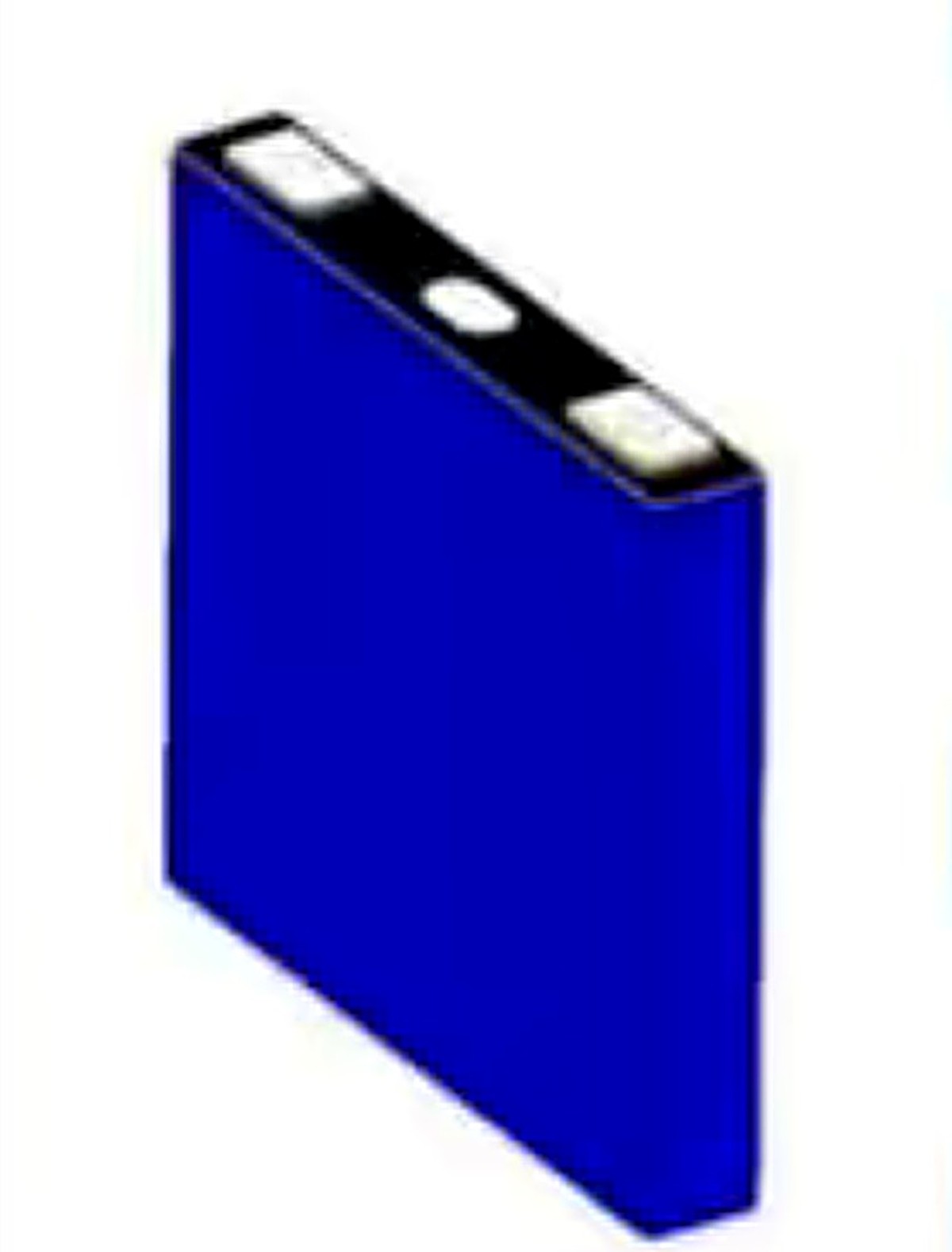
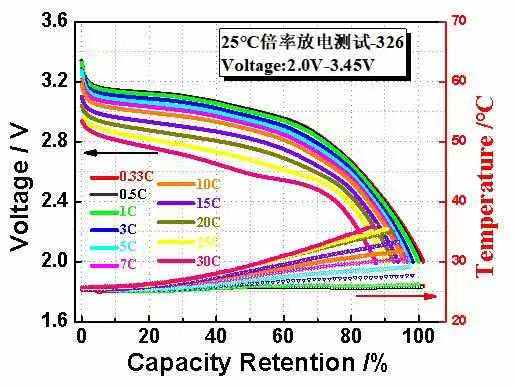
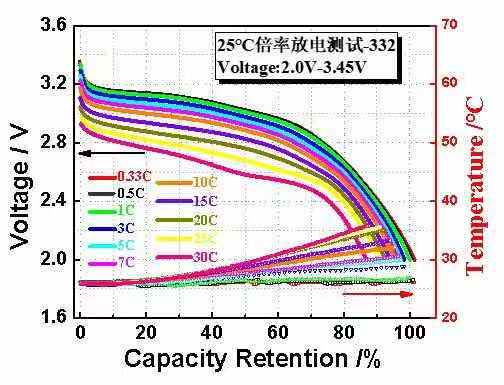
SIB-P10-46 is an aluminum-shell prismatic sodium-ion power cell built for high-rate duty and cold starts. Independent 25°C bench data shows flat rate capability from 0.33C to 30C discharge, and the specification rates it for 10,000 power cycles at 3C/3C between 20–80% SOC.
| Cell format | Prismatic aluminum shell (46 Ah power cell) |
|---|---|
| Dimensions | 175 ±1 mm (W) × 27 ±1 mm (T) × 204 ±1 mm (H) · pole center distance 123 ±0.3 mm |
| Weight | 1.63 ±0.15 kg |
| Nominal voltage | 3.10 V |
| Working voltage | 2.0 – 3.65 V (≥0 °C) · 1.5 – 3.65 V (<0 °C) |
| Nominal capacity | 46 Ah (25 °C, 100% DOD, 1C) |
| Low-temperature capacity | ≥45 Ah (-20 °C, 100% DOD, 1C) |
| Recommended SOC range | 20 – 80% SOC |
| AC impedance | ≤0.35 mΩ (1 kHz) |
| DC impedance | ≤0.7 mΩ (50% SOC, 10C) |
| Energy density | ≥85 Wh/kg · ≥150 Wh/L (25 °C, 100% DOD, 1C) |
| Standard charge | 1C CC-CV: 46 A to 3.65 V, cut-off 0.05C (2.3 A) |
| Max. continuous charge / discharge | 4C / 6C |
| Max. pulse charge / discharge (10 s) | 10C / 20C |
| Cycle life (power) | ≥80% capacity after 10,000 cycles (20–80% SOC, 3C charge / 3C discharge) |
| Operating temperature | -40 ~ 55 °C (recommended -20 ~ 40 °C) |
| Storage | 30–50% SOC, -40 ~ 55 °C (recommended 0–40 °C), self-discharge <5% / 30 days |
| Safety | GB 38031-2020 — pass |
Specification per manufacturer datasheet v4.0 (BOL state, cells within 30 days of manufacture and ≤5 formation cycles). Confirm the current revision before system approval.
Standard charge (25 ±2 °C): discharge at 46 A (1C) to 2.0 V, rest 1 h, then charge at 46 A CC to 3.65 V, switch to CV until current tapers to 2.3 A (0.05C), rest 1 h.
Standard discharge (25 ±2 °C): constant current 46 A (1C) to 2.0 V, rest 1 h.
Power cycling (20–80% SOC): 3C discharge for 720 s, rest 5 min, 3C charge for 720 s, rest 5 min; capacity check every 1,000 cycles until retention falls below 80%.
| Rate | 0.33C | 0.5C | 1C | 3C | 5C | 7C | 10C | 15C | 20C | 30C |
|---|---|---|---|---|---|---|---|---|---|---|
| Current (A) | 15.2 | 23 | 46 | 138 | 230 | 322 | 460 | 690 | 920 | 1380 |
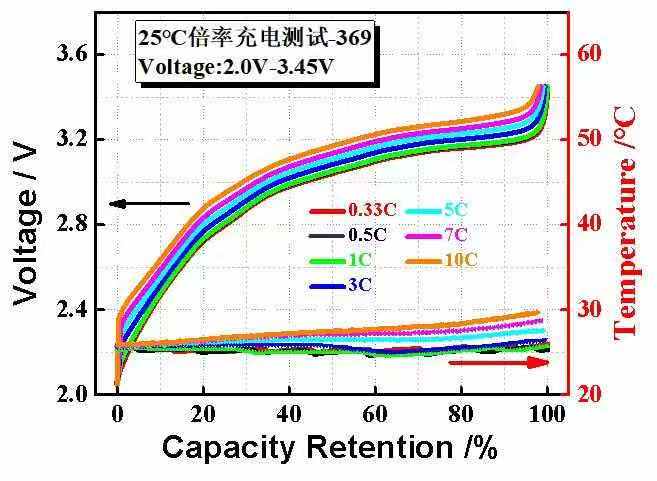
Independent bench curves below cover 0.33C – 30C discharge at 25 °C with simultaneous temperature logging; the knee voltage remains above 2.4 V at 80% depth even at 10C.
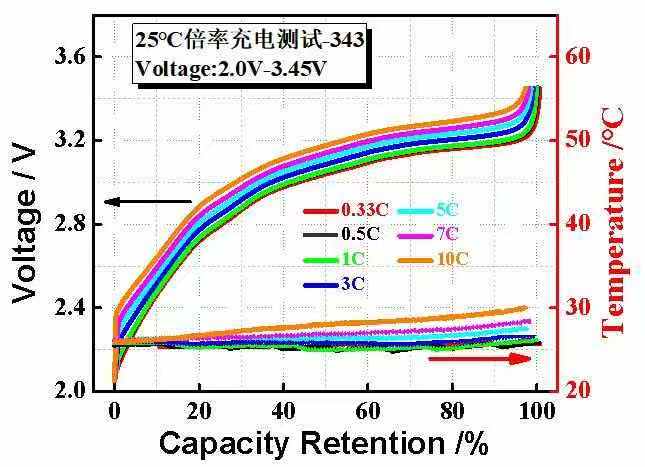
Charge acceptance stays stable from 0.33C to 10C with cell temperature rising only ~10 °C across the sweep — useful for fast-charge and regenerative-duty sizing.
The 10,000-cycle figure is a power-cycling result between 20% and 80% SOC at 3C/3C — the duty profile of hybrid and high-rate applications, not a 100%-DOD energy-throughput rating. For energy-storage sizing at 100% DOD, request the corresponding endurance test report for your project.
Include this model, your application (starter pack, hybrid buffer, fast-charge station buffer or storage), quantity, destination and required delivery date. For high-rate duty, include the pulse profile (current, duration, rest, SOC window) so the power capability can be confirmed against the HPPC method.
Send the application, required specifications, quantity and destination for a model-specific proposal.
Request a quoteFlagshipHigh-rate Prussian-blue start-stop cell — 613 W pulse at 25 °C, 50,000 start-stop cycles.
 New
Large prismatic NFPP storage cell — flat 5C rate, -40 °C capable, 100% DOD cycling proven.
 Low-temp