


Sodium-ion
NaCR26650-25UT — 2.5 Ah Low-Temperature 26650 Cell
70C 3 s pulse, 20C continuous, -40 °C capable
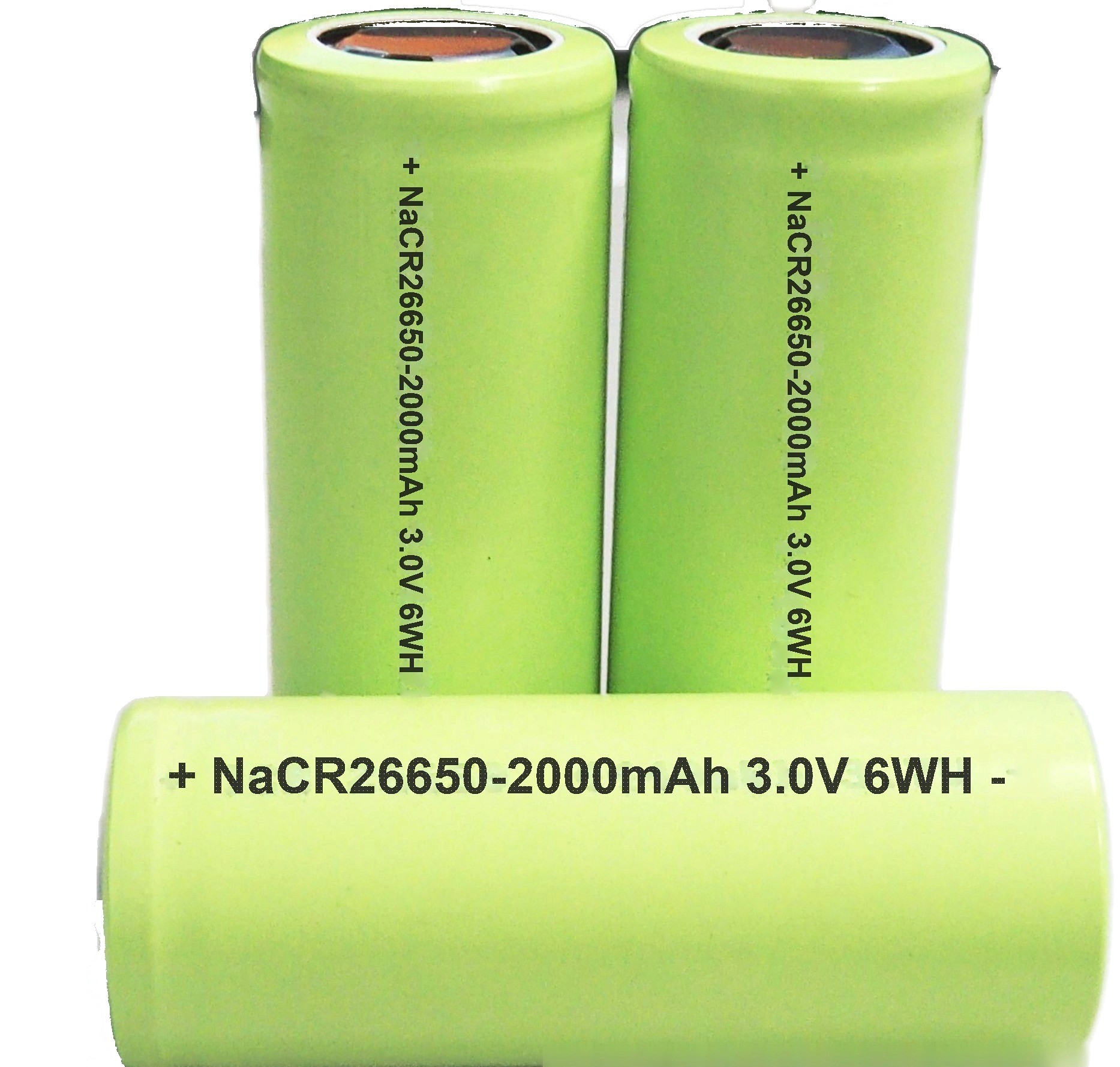
A high-power 26650 cylindrical sodium-ion cell rated 2.0 Ah at 3.0 V. It supports 85C 3-second pulse discharge, 20C continuous discharge and 2,000 cycles at 3C/3C, and still delivers ≥75% of room-temperature capacity at -40 °C. Data from Veken specification VKB-QS-SPE-3015 (A0, 4 November 2025).
| Cell format | 26650 cylindrical sodium-ion cell |
|---|---|
| Dimensions | Φ26.2 ±0.2 mm (with PET film) × 65 ±0.5 mm |
| Nominal voltage | 3.0 V |
| Typical capacity | 2.00 Ah · minimum 1.95 Ah (0.2C, 25 ±2 °C) |
| Weight | 71 ±5 g |
| Max. continuous charge | 3C @ 100% SOC · 6C @ 90% SOC (25 °C) · ≤0.1C at -20 ~ -10 °C · ≤1C at -10 ~ 0 °C |
| Max. continuous discharge | ≤18C at -20 ~ -10 °C · ≤25C at -10 ~ 25 °C · 20C at 25 ~ 45 °C · ≤5C at 45 ~ 75 °C |
| Max. peak discharge | 85C (3 s pulse, >1.8 V) |
| Max. pulse cycle discharge | 25C (3 s pulse) |
| Rate discharge capacity | 0.5C ≥97% · 1C ≥93% · 5C ≥91% · 10C ≥90% · 15C ≥88% · 20C ≥85% |
| Cycle life (25 °C) | 1C/1C 2,000 cycles ≥80% · 3C/3C 2,000 cycles ≥80% |
| Pulse cycle life | 1C charge / 25C 3 s pulse: 1,300 cycles, energy ≥70% (>20,000 pulses) |
| Low-temperature cycling | -10 °C 1C/1C 400 cycles ≥60% |
| High-temperature cycling | 75 °C 3C/3C 1,000 cycles, energy ≥60% |
| Max. charge voltage | 3.95 V |
| Discharge cut-off voltage | 1.5 V |
| Storage temperature | -20 ~ 75 °C (1 month) · 0 ~ 45 °C (3 months) · 0 ~ 25 °C (1 year) |
| Standard charge | 0.5C CC-CV to 3.9 V (cut-off 100 mA) |
| Shipping SOC | 20 – 70% |
| Storage performance | 30 days @ 25 °C: retention ≥90%, recovery ≥95% · 30 days @ 60 °C: retention ≥80%, recovery ≥90% |
Source: Veken Technology product specification VKB-QS-SPE-3015, revision A0, dated 4 November 2025. Values are BOL measurements at 25 ±2 °C unless stated otherwise. Confirm the current datasheet revision before design approval.
After a standard charge to 3.9 V and a 30-minute rest, the cell is discharged at each rate to 1.5 V. Capacity is expressed relative to the 0.2C result.
| 0.2C | 100% (reference) |
|---|---|
| 0.5C | ≥ 97% |
| 1C | ≥ 93% |
| 5C | ≥ 91% |
| 10C | ≥ 90% |
| 15C | ≥ 88% |
| 20C | ≥ 85% |
Standard charge at 25 ±2 °C, then 12 h soak at sub-zero temperatures (4 h at 25 °C / 75 °C) and 1C discharge to 1.5 V. The 25 °C result is the 100% reference.
| Cell temperature | Capacity retention vs 25 °C |
|---|---|
| -40 °C | ≥ 75% |
| -30 °C | ≥ 80% |
| -20 °C | ≥ 85% |
| -10 °C | ≥ 90% |
| 0 °C | ≥ 92% |
| 25 °C | 100% (reference) |
| 75 °C | ≥ 95% |
Cold-cranking reference: after a 24 h soak at -18 ±1 °C, a 20C constant-current discharge holds ≥2.0 V minimum voltage over the first 10 seconds.
Standard charge (25 ±2 °C): 0.5C constant current to 3.9 V, then constant voltage until current falls to 100 mA. Maximum charge voltage 3.95 V; maximum continuous charge 3C at 100% SOC or 6C at 90% SOC (25 °C).
Standard discharge (25 ±2 °C): 0.2C constant current to 1.5 V cut-off.
Cycle life: 1C or 3C CC charge to 3.65 V, CV to 0.05C, rest 10–30 min; 1C or 3C CC discharge to 2.0 V, rest 30 min. Capacity retention ≥80% after 2,000 cycles.
Pulse cycling: 1C CC-CV charge to 3.65 V, rest 30 min; 25C discharge for 3 s, rest 5 s, repeated 16 times, then rest 60 min — repeated for 1,300 cycles (>20,000 pulses) with ≥70% energy retention.
The 20HP trades a little capacity for burst power: 2.0 Ah with an 85C 3-second peak, versus 2.5 Ah and 70C for the 25UT. Continuous cycling is rated at ≥80% capacity after 2,000 cycles at both 1C/1C and 3C/3C in the 2.0–3.65 V window.
Under a pulse profile (1C charge, 25C 3-second discharge pulses) it completes 1,300 cycles — more than 20,000 pulses — with ≥70% energy retention. Low-temperature cycling is specified at 400 cycles at -10 °C (1C/1C, ≥60% retention), and high-temperature cycling at 1,000 cycles at 75 °C (3C/3C, ≥60% energy retention).
The specification requires no fire and no explosion in over-discharge (1C, 90 min), overcharge (3C to 10 V), external short circuit (80 ±20 mΩ, 10 min), 130 °C hot-box exposure (30 min), crush, 1.0 m drop and impact testing. Cells are supplied at 20–70% SOC and should be integrated with a BMS that enforces the voltage, current and temperature limits in the specification.
High-current pulse modules, starter and emergency-start packs, power tools and actuator drives, hybrid buffers, UPS and backup modules, and cold-region equipment that needs strong burst output from a compact 26650 cell.
State the model, application, quantity, destination and required delivery date. For pulse duty include the pulse profile (current, duration, rest interval and SOC window) and the ambient temperature range so the power capability and low-temperature limits can be checked against your duty cycle.
Send the application, required specifications, quantity and destination for a model-specific proposal and datasheet.
Request a quote70C 3 s pulse, 20C continuous, -40 °C capable

